If you’re sourcing disposable cups for coffee shops, restaurant chains, or distribution, one of the first questions you’ll ask is about heat. How hot can these cups actually get? Will they hold up through a busy morning rush, or will you end up with leaks, complaints, and wasted product?
It’s a simple question, but the answer isn’t a single number.
There’s no universal heat-resistance temperature that applies to every paper cup. What a cup can handle depends on the paper quality, how it’s constructed, what’s inside, and how it’s used. Let’s walk through what actually matters so you can make better decisions when buying.
What Heat Resistance Actually Means?
Before we get into temperatures, let’s be clear about what we’re talking about.
Heat resistance for a disposable cup means the cup keeps its shape, stays sealed, and can be handled safely when filled with a hot drink. It’s not just about surviving a few seconds of contact with hot liquid. It’s about holding up through the time it takes a customer to actually drink their coffee or tea.
A cup that fails heat resistance will soften, deform, leak from the seams, or collapse. Sometimes it’s sudden. More often, it happens gradually as heat and moisture weaken the paper over time.

Different Materials Perform Differently
Different cup materials handle heat differently. Here’s what you need to know about the two main types you’ll encounter.
Paper Cups
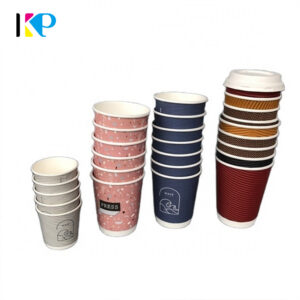
These are what most people think of when they imagine a disposable hot cup. Traditional paper cups use paperboard made from wood pulp. The heat resistance comes down to the quality and thickness of that paperboard. A higher GSM (grams per square meter) gives you more structure. Most standard hot cups start around 240-280 GSM, and that’s where you want to be for hot drinks.
But the paper is only half the equation. These cups rely on an inner lining to keep moisture from soaking through. That lining does most of the real work when it comes to heat performance.

Sugarcane Bagasse Cups
Bagasse comes from the leftover plant material after sugarcane is crushed for juice. It’s a natural fiber that’s increasingly popular in food packaging.
From a heat perspective, bagasse cups tend to be quite robust. The natural fiber structure holds up well. That said, performance still depends on the specific product. A well-made bagasse cup can handle hot beverages comfortably, but you should always check the supplier’s specs rather than assume all bagasse cups are the same.

Choosing between paper and bagasse comes down to your application, product specifications, and what your supplier can provide.
The Inner Lining Is Where the Action Is
The lining is what actually touches your beverage. It’s the barrier that keeps liquid from soaking through the paper. Choose the wrong lining, and nothing else will save you.
PE (Polyethylene) Coating
PE is the standard lining for traditional paper cups. It’s reliable, cost-effective, and performs well with hot beverages. Most PE-coated cups hold up to about 90-100°C. The coating prevents leaks while the paper provides structure.
For standard hot beverage service, PE works well. It’s widely available and proven in the field.
PLA (Polylactic Acid) Lining
PLA is a plant-based bioplastic that’s becoming more common as businesses look for compostable alternatives. PLA-lined cups typically handle up to 90-95°C.
The catch is that PLA can soften at higher temperatures. Around 93°C, it starts to lose some rigidity. Some products advertise heat resistance up to around 104°C, but those are specific formulations. Don’t assume standard PLA cups can handle the same temperatures as PE.
Other Factors That Affect Performance
Even with the same material and lining, cups perform differently. Here’s what else you need to consider.
Wall Thickness and Construction
Thicker paperboard insulates better and holds up longer. Double-wall construction adds an extra layer of protection. With double-wall cups, the exterior stays more comfortable to hold because there’s an air gap that slows heat transfer. That’s a real advantage if you’re serving drinks that will be held for a while.
What You're Serving
Think about your actual beverage temperatures:
- Coffee is typically served at 60-85°C
- Tea often comes out at 70-90°C
- Hot chocolate sits around 65-80°C
- Hot water can approach boiling at 90-100°C
Most hot beverage cups are designed to handle these ranges. Standard hot cups are generally safe up to 100°C. But if you’re serving especially hot beverages or using equipment that dispenses near-boiling water, you need to check the specs.
How Long the Drink Stays in the Cup
This matters more than people think. A cup that holds a hot beverage for 30 minutes faces different demands than one for a quick takeaway. Extended exposure to heat and moisture gradually weakens the structure. If your customers tend to sip slowly or take drinks to go, consider a heavier cup.
Cup Size
Larger cups contain more hot liquid, which means more weight and more heat pressure on the structure. A 24 oz cup needs stronger construction than an 8 oz cup. Higher GSM paper is often recommended for larger sizes.
Manufacturing Quality
Seam construction, rim reinforcement, and overall build quality all affect performance. A well-made cup with tight seams and proper lamination will outperform a poorly made cup, even if the materials are identical.
How to Test Before You Buy
Testing is straightforward, and you should always do it before placing a large order.
Get samples that represent the final product. Fill them with the actual beverages you’re going to serve at the temperatures you’ll actually use. Let them sit for the longest amount of time a customer is likely to hold the drink.
Check for leaks at the seams and the bottom. Look for softening and deformation. Pick the cup up and see how it feels. Does the lid still fit after the cup has been filled for a while?
Your supplier should be able to provide clear specifications and discuss their quality control.
Practical Guidance for Buyers
01
For standard coffee and tea service
Traditional PE-coated paper cups are a safe, reliable choice. Just make sure you’re using adequate GSM for your cup size.
02
If you're serving very hot beverages
Confirm with your supplier that the cup handles that specific temperature. Consider higher GSM or double-wall options.
03
If your customers tend to hold drinks for extended periods
Go with higher-quality paperboard and robust linings. Test for performance over time, not just at the moment of fill.
04
if you're looking at bagasse as an alternative
Understand its heat limitations. It can work well, but not all bagasse cups are the same. You need to check the product specs.
The Bottom Line
Heat resistance isn’t a single number you can just look up. It depends on the specific cup, the specific beverage, and how that cup is actually used.
When you’re evaluating products, pay attention to:
- The material and paperboard quality
- Whether the cup is single-wall or double-wall
- The type of inner lining
- Your actual beverage temperature
- How long the cup will be in use
- The cup size and intended application
- Testing with samples under real conditions
- What the supplier’s specifications actually say
KP offers both paper cups and sugarcane bagasse cups. Their team can help you figure out what works best for your needs. Reach out for samples, specifications, or to discuss your next order.