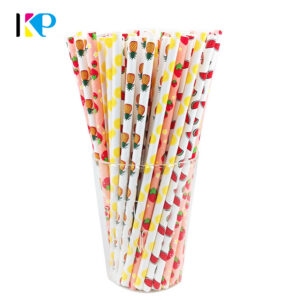
If you buy disposable paper straws in bulk, you already know that not all paper straws are created equal. But have you thought about how temperature and humidity might be affecting your product before it even reaches your customer?
Environmental conditions can have a real impact on paper straw performance. For B2B buyers—importers, distributors, restaurant chains, cafés, and beverage brands—understanding these factors can help you choose the right product and avoid customer complaints.

Temperature and Paper Straws: What Matters?
Temperature matters for paper straws in two main ways: the environment they’re stored in and the beverages they’re used with.
Storage Temperature
Paper absorbs and releases moisture from the air. That’s just what paper does. Temperature matters because it can drive condensation. A warm warehouse that cools down at night can create moisture cycling inside cartons. That moisture can soften paper straws, reduce their stiffness, and make them more vulnerable to crushing.
Most paper straws are designed for room-temperature storage, away from direct sunlight and moisture. Keep them in a stable, dry environment and you’ll avoid most storage-related problems.
Beverage Temperature: Cold vs. Hot
The temperature of the drink itself is where many buyers see the biggest performance differences.
For cold beverages, most paper straws perform well. But how cold is cold? The actual tolerance depends on the paper quality, number of layers, coating, and adhesive used. One straw might hold up fine in an iced latte while another starts to soften after a few minutes.
Hot beverages are a different story. Not all paper straws are designed for hot drinks. Research shows that some alternatives soften above 55°C, and paper straws have their own limitations. A straw that works perfectly in iced coffee may become soft and unappealing in hot tea or coffee.
The length of time the straw stays in the beverage also matters. A quick drink versus a slow, leisurely sip can produce very different results—even with the same straw and drink temperature.

The Humidity Factor
If temperature is one side of the coin, humidity is the other. And for paper straws, humidity is often the bigger concern.
Paper Absorbs Moisture
Paper straws are made from wood pulp. Even with coatings and surface treatments, they remain paper products. If the surrounding air is humid for an extended period, the straws will absorb moisture. That can affect stiffness, surface condition, and structural strength.
This is not theoretical. Straws stored in high-humidity conditions can lose significant bending strength over a matter of days. The straws may feel soft before they are ever used. The mouth end may become wrinkled or distorted. In some cases, they may be more prone to crushing or bending when inserted into a drink.
Where Humidity Becomes an Issue
Humidity tends to be most relevant in a few specific scenarios:
Most paper straws are designed for room-temperature storage, away from direct sunlight and moisture. Keep them in a stable, dry environment and you’ll avoid most storage-related problems.
- Ocean shipping through tropical climates
- Warehouses in coastal or high-humidity regions
- Seasonal changes that bring prolonged damp weather
- Storage near areas where condensation occurs
*The product is most vulnerable when it sits in these conditions for weeks or months. The longer the exposure, the greater the risk.
Packaging and Protection
Packaging plays a big role here. Individual wrapping provides an extra barrier against moisture. Sealed cartons provide more protection than open cases. And how the product is stored inside the warehouse matters too. Cartons kept off the floor, away from exterior walls, and away from loading docks will generally fare better than those stacked in more exposed locations.
Storage Conditions and Shelf Life
Shelf life for paper straws is not a fixed number. It depends on the material, the coating, the construction, the packaging, and the storage environment. A straw stored in a climate-controlled warehouse in a dry climate will last differently from one stored in an uninsulated shed in the tropics.
We typically recommend storing paper straws in ventilated, dry areas away from direct sunlight and ground contact. This is not just generic advice. It reflects the reality that paper products need basic protection from environmental moisture.
If a supplier specifies a shelf life, that shelf life usually assumes the recommended storage conditions are met. If those conditions are not met, the number becomes less reliable.
Not All Paper Straws Are Built the Same
It is worth emphasising that paper straws are not interchangeable. Performance depends on the specific product design, and that design varies between manufacturers and product lines.
Key construction factors include the quality of the paper, the number of layers, the thickness of the walls, the type of adhesive, the surface treatment, and the coating. A multi-ply straw with a water-resistant coating may behave very differently from a single-layer straw with minimal treatment. Similarly, a straw designed for cold beverages may not perform well in hot drinks, no matter how many layers it has.
You should not assume that more layers automatically means better performance. The appropriate specification depends on the intended use. A straw for a smoothie may need different characteristics than one for iced tea or a hot latte. The best approach is to discuss the application with the supplier and test samples before ordering at scale.
What to Test Before Buying
Because performance can vary, sample testing is a practical step before committing to a large order. It is not about being difficult. It is about making sure the product works for the actual application.
Things to check include:
- Stiffness and surface condition straight out of the box
- How the straw performs in the intended beverage at the intended temperature
- Whether the straw holds up for the expected contact time
- Whether the packaging arrives in good condition
- Whether the product behaves consistently from one carton to the next

Working with a Supplier Who Understands the Variables
Given all these factors, working with an experienced supplier makes a difference. A supplier who understands how material, construction, and environment interact can help choose the right product for the application.
KP supplies disposable paper straws and works with B2B customers on product specifications, customisation, packaging, and bulk orders. Whether you are importing, distributing, or serving drinks directly, having a clear conversation about the intended use and storage conditions can help avoid performance issues.